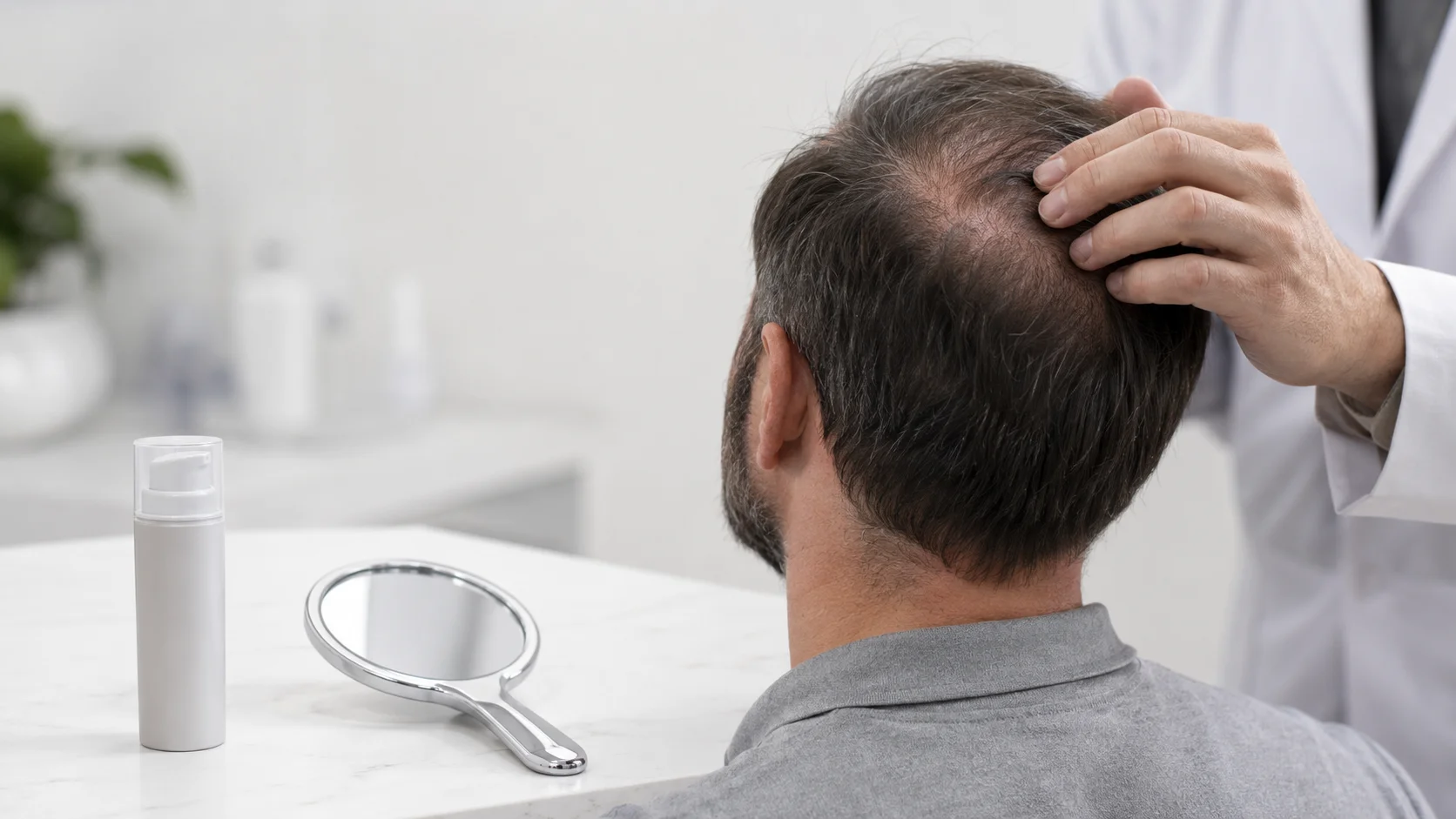
Clascoterone, also known by the development name Breezula for hair loss, is a topical anti-androgen being studied for androgenetic alopecia. Unlike treatments that lower DHT throughout the body, clascoterone is designed to act locally at the scalp — reducing androgen signaling around susceptible hair follicles without broadly changing hormone levels in the bloodstream.
Clascoterone is not the same as minoxidil, and it is not simply a topical version of finasteride. It belongs to a different category: topical androgen receptor inhibition. This article compares it directly against finasteride, the most established oral treatment that works on the same androgen pathway from a different angle, so the distinction between "lowering DHT" and "blocking the androgen receptor" is concrete rather than abstract.
Clascoterone is the drug name; Breezula is the name associated with its development for androgenetic alopecia. Clascoterone has also been studied and used in dermatology in other forms for androgen-related skin conditions, but the hair-loss formulation, concentration, and approval pathway are a separate matter — a product approved for one skin condition should never be assumed interchangeable with a hair-loss formulation.
How Pattern Hair Loss Happens
In androgenetic alopecia, hair follicles in genetically susceptible areas of the scalp gradually become smaller — a process called follicular miniaturization. DHT is one of the main hormones involved: it binds to androgen receptors in sensitive follicles and contributes to a shorter growth phase, thinner hair shafts, and progressive density loss. (See What Is DHT and How Does It Cause Hair Loss? for the full mechanism.)
This does not mean everyone with pattern hair loss has unusually high testosterone or DHT. Many people have hormone levels within the normal range — the key issue is often follicle sensitivity, not simply hormone excess.
How Finasteride Works
Finasteride is a 5-alpha reductase inhibitor. It reduces the conversion of testosterone into DHT, the androgen most strongly associated with pattern hair loss in genetically sensitive follicles. By lowering DHT levels, finasteride can slow miniaturization and help stabilize hair loss in many men with androgenetic alopecia; some users also see partial regrowth, especially where follicles are still active.
Finasteride is commonly taken orally for male pattern hair loss. Topical forms are also discussed and used in some settings, but availability, regulation, dosing, and evidence vary by location and formulation. (See Finasteride and Hair Loss: Complete Guide.)
How Clascoterone Works at the Follicle
Clascoterone is designed as an androgen receptor antagonist. Instead of reducing DHT production, it aims to limit androgen signaling by competing at the receptor level in the skin and scalp follicle environment — a fundamentally different strategy from 5-alpha reductase inhibitors.
In simple terms: finasteride reduces how much DHT is produced, while clascoterone is intended to reduce how strongly androgens can act locally where the medication is applied. That receptor-focused mechanism is why clascoterone is often described as a topical anti-androgen rather than a DHT-lowering drug — it does not belong to the same pharmacological class as finasteride.
How Clascoterone Differs From Minoxidil
Minoxidil and clascoterone approach hair loss from different angles. Minoxidil is not primarily an anti-androgen — it supports hair growth by influencing follicle activity and prolonging the growth phase in some users. Clascoterone, by contrast, is focused on androgen signaling: its purpose is not to stimulate growth directly but to interfere with a hormonal pathway involved in follicle miniaturization.
This difference means the two may eventually be discussed as complementary rather than identical — one targets growth support, the other targets androgen receptor activity. Any combination approach would still need to be evaluated by a qualified clinician.
Topical Local Action vs Oral Systemic Action
One of the most important practical differences between the two drugs is route of treatment. Oral finasteride works systemically — it changes DHT levels throughout the body, not only on the scalp. Clascoterone for hair loss is being developed as a topical scalp medication, aiming for more localized activity, although any topical medication still needs safety evaluation for absorption, irritation, and long-term use.
A local approach may appeal to people cautious about systemic hormonal effects. However, "topical" should not be interpreted as automatically side-effect-free or equally effective.
Where the Evidence Stands, and What Is Approved
Finasteride has a long clinical history for male pattern hair loss. In the pivotal two-year trial of 1,553 men, finasteride 1 mg produced statistically significant hair-count gains over placebo — roughly 107 additional hairs at one year and 138 at two years, against a progressive decline in the placebo group (Kaufman KD et al., J Am Acad Dermatol 1998).
Clascoterone's regulatory history runs on a separate track. Clascoterone cream 1% received its first regulatory approval in August 2020 for acne, not for hair loss; at that time a separate, higher-concentration clascoterone solution for androgenetic alopecia was still in clinical testing, not yet approved (Dhillon S, "Clascoterone: First Approval," Drugs 2020). Readers should not assume that an approval for one condition extends to the other, and should confirm current approval status for the hair-loss formulation directly with a pharmacist or regulator rather than from this article.
Which Treatment Is More Effective?
There is no simple universal answer. Finasteride has decades of accumulated evidence in men with androgenetic alopecia, including the hair-count data above. Clascoterone may offer a different mechanism, but its place in treatment depends on completed trial results, approvals, dosing, adherence, and real-world experience that is still accumulating.
Effectiveness also depends on timing: earlier-stage androgenetic alopecia typically responds better to medical management than advanced areas where follicles are severely miniaturized or inactive. Treatment success should be judged over months, not weeks — stabilization, reduced shedding, improved density, and patient satisfaction are all different outcomes worth tracking separately.
Safety and Side Effects
Finasteride may cause side effects in some users, including sexual side effects, breast tenderness or changes, and mood-related concerns that should be discussed with a clinician; many users tolerate it well, but the risk-benefit balance is individual.
Clascoterone's topical route raises different safety questions. Because it is scalp-applied, many people hope it may carry fewer systemic side effects than oral anti-androgens — but topical does not automatically mean risk-free. Possible concerns include irritation, redness, dryness, itching, flaking, or sensitivity to the formulation, and broader systemic effects from absorption still require careful long-term monitoring once larger numbers of people use it in everyday settings.
Could Clascoterone and Finasteride Be Used Together?
In theory, treatments acting at different points in the androgen pathway could be complementary — finasteride reduces DHT production, while clascoterone targets receptor activity locally. Combining treatments should not be done casually, though: more treatment is not always better, and combined regimens can increase complexity, cost, irritation risk, and the difficulty of identifying which drug is causing a given side effect.
A clinician can help decide whether a single treatment or a combination approach makes sense based on diagnosis, goals, response, and safety profile.
Who Might Prefer Finasteride
Finasteride may be considered by men with androgenetic alopecia who are appropriate candidates for an established DHT-lowering treatment, especially when the goal is to slow progression and preserve existing hair. It is not suitable for everyone — people with certain medical concerns, medication interactions, reproductive considerations, or strong concerns about systemic effects should discuss alternatives with a qualified professional.
Who Might Be Interested in Clascoterone
People most interested in clascoterone are usually those with androgenetic alopecia who want a treatment that targets androgen activity at the follicle level — including people who cannot use, do not tolerate, or prefer to avoid existing anti-androgen medications, or who are following newer treatment development generally.
Suitability depends on factors such as sex, age, diagnosis, pregnancy considerations, medical history, other medications, scalp condition, and the pattern and stage of hair loss. Not all shedding is androgenetic alopecia, and using an androgen-focused treatment for the wrong type of hair loss may delay appropriate care. Women, especially those who are pregnant or could become pregnant, require careful medical evaluation before any anti-androgen-related treatment is considered.
Why Diagnosis Still Matters
Hair loss can be caused by many conditions, including telogen effluvium, alopecia areata, traction alopecia, scarring alopecias, thyroid disorders, nutritional deficiencies, medication effects, and inflammatory scalp disease. Both clascoterone and finasteride are discussed mainly in relation to androgenetic alopecia — if the actual cause of shedding is not androgen-driven, neither treatment addresses the underlying problem.
A clinician may evaluate the pattern of loss, scalp appearance, medical history, family history, medications, and sometimes bloodwork or scalp examination. This helps avoid treating every type of hair loss as if it were pattern hair loss, and it is the step that should come before choosing between an established oral treatment and a newer topical one.
Frequently Asked Questions
Is clascoterone the same as Breezula?
Clascoterone is the drug name, while Breezula is the development name commonly associated with the hair-loss formulation. The terms are often used together, but formulation and approved use matter — see the approval-status section above.
Is Breezula approved for hair loss?
As of the clascoterone acne-cream approval in 2020, the higher-concentration hair-loss formulation was still in clinical testing, not approved. Availability for hair loss depends on regulatory approval and market launch in a given country, which can change — rely on official medical or regulatory guidance rather than this article for current status.
Does clascoterone lower DHT?
Not in the way finasteride does. Clascoterone is designed to reduce androgen receptor signaling locally in the scalp rather than lowering DHT production throughout the body.
Can women use clascoterone for hair loss?
Potential use in women would depend on the approved indication, clinical evidence, pregnancy-related safety considerations, and professional guidance. Anti-androgen-related treatments require careful evaluation in people who could become pregnant.
Should someone switch from finasteride to clascoterone?
Switching should be a medical decision, not a self-directed one. Stopping an effective treatment may allow hair loss to progress, and replacing it with a newer option should be guided by evidence, availability, and individual risk factors — not by mechanism novelty alone.