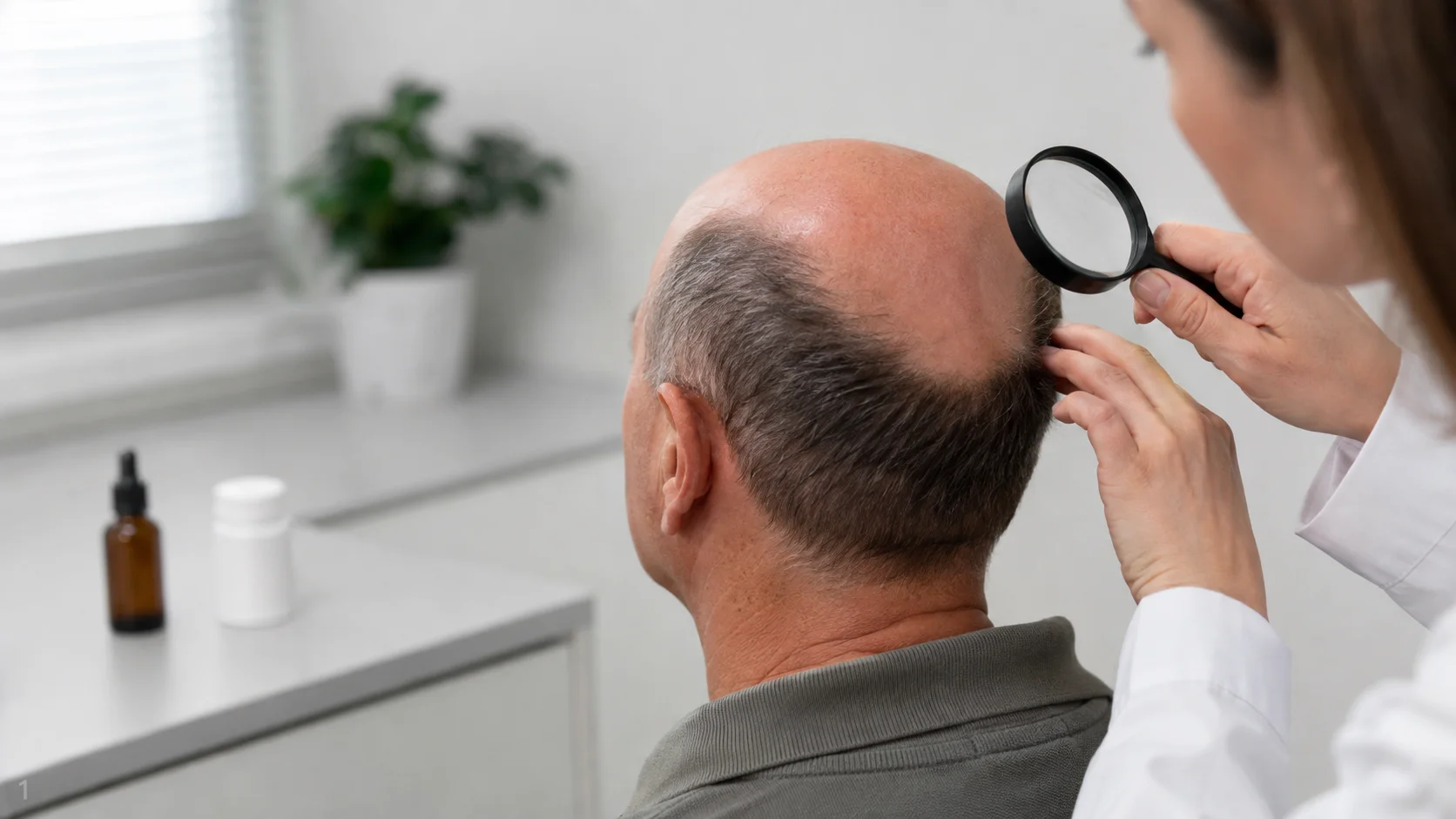
Norwood 7 is the most advanced category on the Hamilton-Norwood scale for male pattern hair loss. At this stage, the frontal scalp, mid-scalp, and crown have usually merged into one extensive area of hair loss, leaving a relatively narrow horseshoe-shaped band around the sides and back.
Significant natural regrowth at Norwood 7 is unlikely. Medical treatment may preserve or thicken surviving miniaturized hairs, but it generally cannot restore the density or coverage of an earlier Norwood stage. Even hair transplantation has important limitations because the available donor supply is much smaller than the recipient area.
What Norwood 7 Means
The Norwood scale describes the visible distribution of male pattern hair loss. Norwood 7 typically involves:
- Extensive loss across the front, top, and crown
- Disappearance of the hair bridge that once separated frontal and crown loss
- A narrow remaining band around the sides and back
- Possible thinning or recession within the donor fringe
- A very large scalp area requiring coverage
The classification does not measure the exact number of surviving follicles. Some apparently bald areas may still contain miniaturized hairs, while long-standing smooth regions may have very limited capacity to produce cosmetically useful growth.
Can Norwood 7 Hair Grow Back Naturally?
Substantial spontaneous regrowth is not expected in advanced androgenetic alopecia. Without treatment, susceptible follicles generally continue to miniaturize.
Temporary changes in scalp visibility can occur when shedding improves, hair grows longer, or lighting and styling change. These should not be confused with reversal of advanced pattern hair loss.
If the loss developed unusually quickly, the diagnosis should be reassessed. Telogen effluvium, alopecia areata, inflammatory disease, medication effects, or nutritional deficiency can coexist with pattern hair loss and may contribute a reversible component.
Can Medication Restore Norwood 7 Hair?
Medication may still have value, but expectations must be conservative. Treatment is most effective when miniaturized follicles remain active and is generally better at preserving hair than recreating coverage in long-bald areas.
Finasteride
Finasteride reduces the conversion of testosterone to dihydrotestosterone, an androgen involved in follicular miniaturization. In suitable men, it may slow further loss and thicken some miniaturized hairs.
At Norwood 7, visible improvement is more likely in areas containing fine surviving hairs than in completely bald regions. Treatment requires continued use to maintain benefit.
Potential sexual, reproductive, mood-related, and breast-related adverse effects should be reviewed with a clinician. Finasteride is not appropriate for everyone.
Topical Minoxidil
Topical minoxidil may prolong the growth phase and improve the diameter of some surviving hairs. It cannot create new follicles.
Consistent use for several months is needed before response can be judged. Scalp irritation, unwanted facial hair growth, and temporary early shedding can occur. Any benefit generally diminishes after treatment is stopped.
Oral Minoxidil
Low-dose oral minoxidil is used off-label for selected hair-loss patients. It may improve miniaturized hair but carries systemic risks, including fluid retention, rapid heartbeat, dizziness, blood pressure changes, and unwanted body-hair growth.
Cardiovascular history, kidney function, medications, and blood pressure should be considered before treatment.
Dutasteride and Other Options
Dutasteride suppresses dihydrotestosterone more extensively than finasteride and is used off-label for hair loss in some jurisdictions. Greater hormonal suppression does not guarantee meaningful regrowth at Norwood 7 and requires careful risk assessment.
Platelet-rich plasma and low-level light therapy may be discussed as adjuncts, but evidence and response vary. They should not be presented as substitutes for an adequate donor supply or as methods capable of fully reversing advanced baldness.
Is a Hair Transplant Always Possible?
No. Norwood 7 creates one of the most difficult transplant-planning situations. Donor hair is finite, while the recipient area is exceptionally large.
A transplant redistributes existing follicles from the back and sides. It cannot produce new donor hair or recreate natural density over the entire scalp.
Candidacy depends on:
- Density within the safe donor zone
- Hair-shaft thickness
- Number of hairs per follicular unit
- Degree of donor miniaturization
- Size and stability of the donor region
- Scalp laxity if strip harvesting is considered
- Previous procedures or scars
- Hair-to-scalp color contrast
- Curl and styling characteristics
- Willingness to accept limited coverage
A person with a strong donor area and favorable hair characteristics may obtain a conservative result. Someone with a narrow or miniaturized donor fringe may not be a suitable candidate.
What Can a Transplant Realistically Achieve?
The most realistic strategy is usually selective coverage rather than uniform density. Planning may prioritize the frontal frame because it has a greater visual effect than distributing sparse grafts across the entire scalp.
Possible approaches include:
- Creating a conservative, age-appropriate frontal hairline
- Concentrating grafts in the frontal scalp
- Accepting lower density through the mid-scalp
- Leaving the crown untreated or lightly treated
- Combining more than one carefully planned procedure
- Preserving donor reserves for future needs
Attempting a low, dense hairline or full crown coverage can consume too much donor hair and leave an unfinished appearance behind it.
Body hair may sometimes supplement scalp grafts, but it differs in texture, growth cycle, length, and reliability. It is not equivalent to a strong scalp donor supply.
Nonsurgical Appearance Options
For some people, cosmetic options provide more predictable coverage than surgery.
Scalp micropigmentation can reduce the contrast between scalp and hair or create the appearance of a closely shaved head. It does not add hair and requires careful design, pigment selection, and long-term maintenance.
Hair systems can provide immediate and extensive coverage without consuming donor follicles. Limitations include attachment, cleaning, replacement, cost, and lifestyle preferences.
Hair fibers and concealers require enough existing hair to hold the product, so they may have limited value in extensive smooth areas.
How to Evaluate Claims of Complete Regrowth
Before-and-after photographs can be misleading when they use different hair lengths, lighting, angles, styling, or scalp pigmentation. Results should be assessed with consistent images and a clear explanation of whether medication, transplantation, fibers, or micropigmentation contributed.
Treatments claiming to regenerate a full head of hair from a Norwood 7 pattern should be approached cautiously. Experimental methods should not be represented as established follicle-creation therapies.
Frequently Asked Questions
Can finasteride reverse Norwood 7?
It may stabilize loss and improve surviving miniaturized hairs, but it is unlikely to restore extensive bald areas to an earlier Norwood stage.
Can minoxidil regrow a bald crown?
Response is more likely where miniaturized hairs remain. A long-standing smooth crown is generally less responsive.
Is Norwood 7 too advanced for a transplant?
Not automatically, but candidacy depends heavily on donor capacity and expectations. Some patients are unsuitable even when they are willing to accept limited coverage.
Can beard hair provide full scalp coverage?
Beard grafts may supplement scalp hair in selected cases, but their texture and growth differ. They cannot guarantee complete or natural-looking coverage across a large scalp.
Is a hair system a medical treatment?
No. It is a cosmetic appearance-management option and does not slow androgenetic alopecia.
A Realistic Goal
At Norwood 7, the objective is rarely complete biological restoration. Medical treatment may preserve or strengthen remaining follicles, while surgery may redistribute limited donor hair strategically. The best plan is the one that acknowledges the size of the bald area, protects the donor zone, and chooses achievable cosmetic priorities.
This content is for general informational purposes and does not replace individualized medical advice, diagnosis, or treatment.