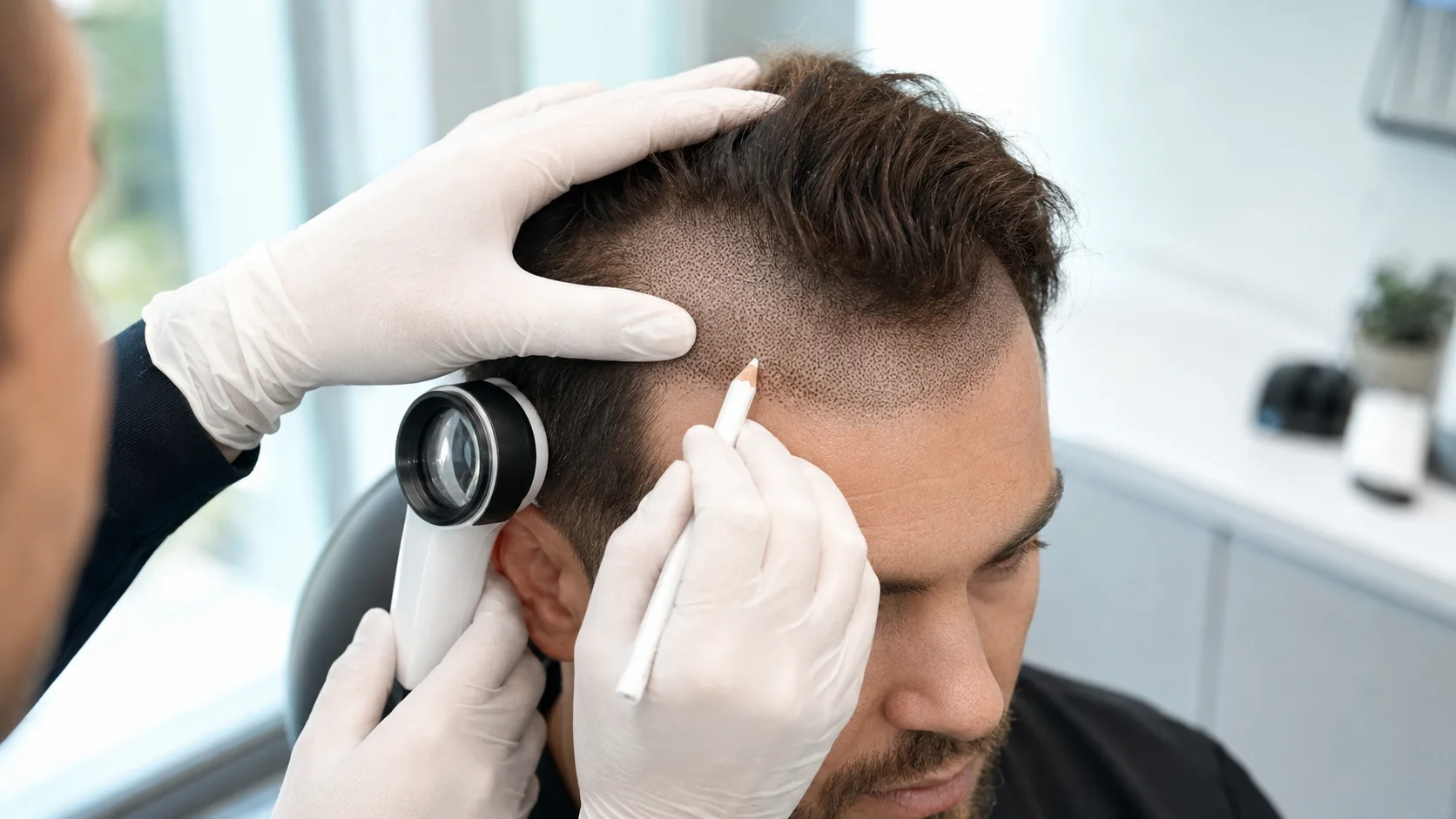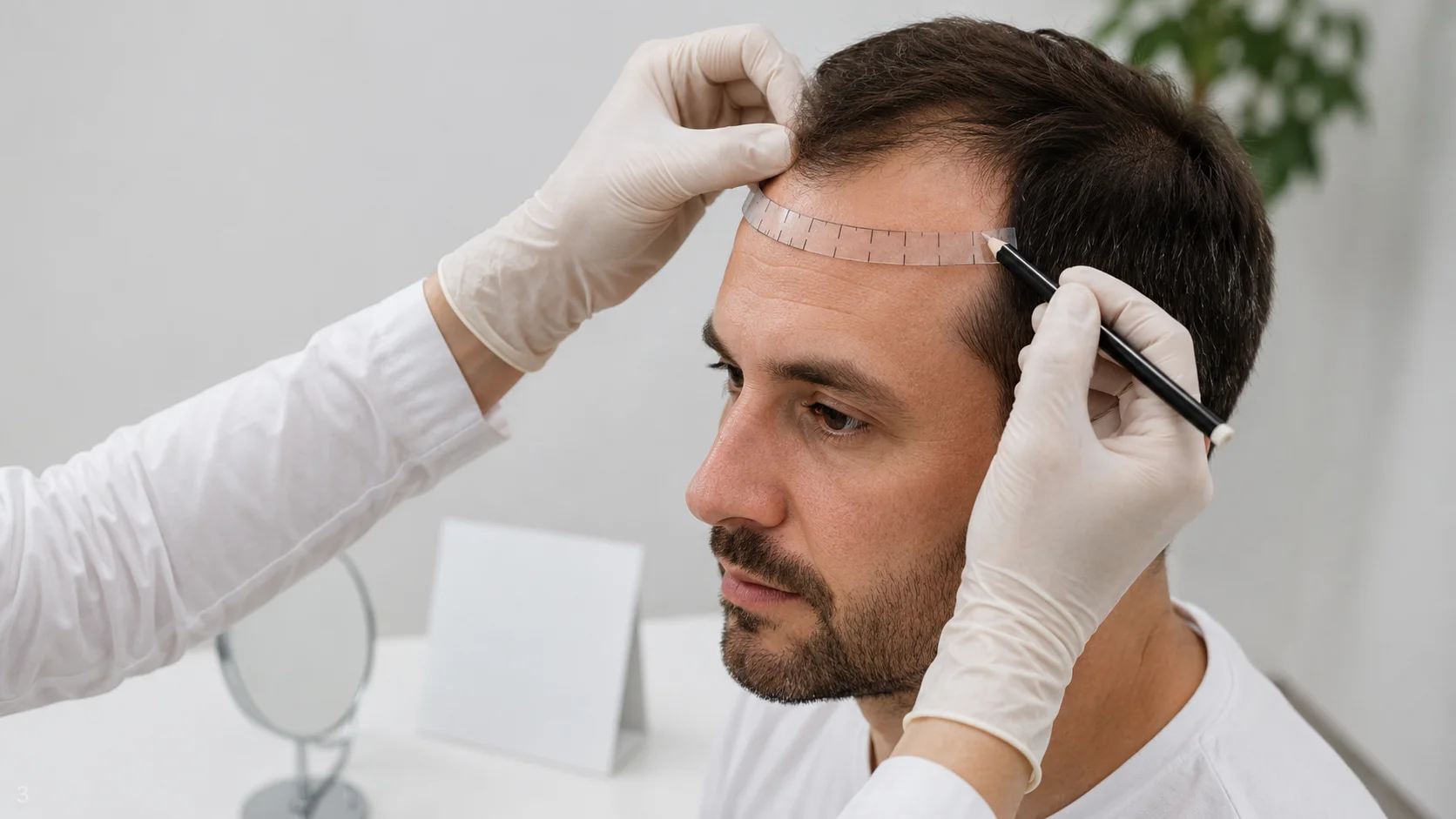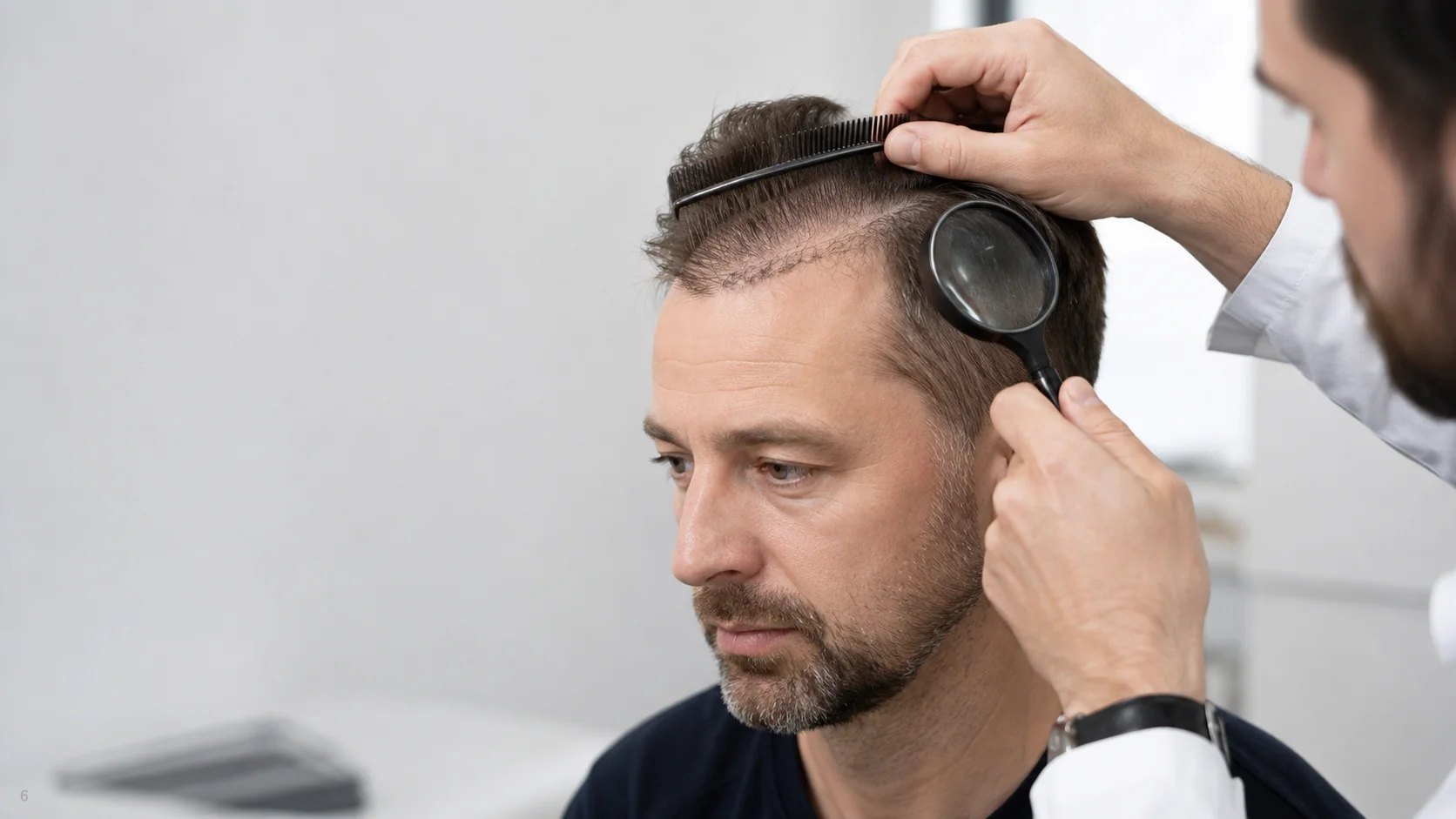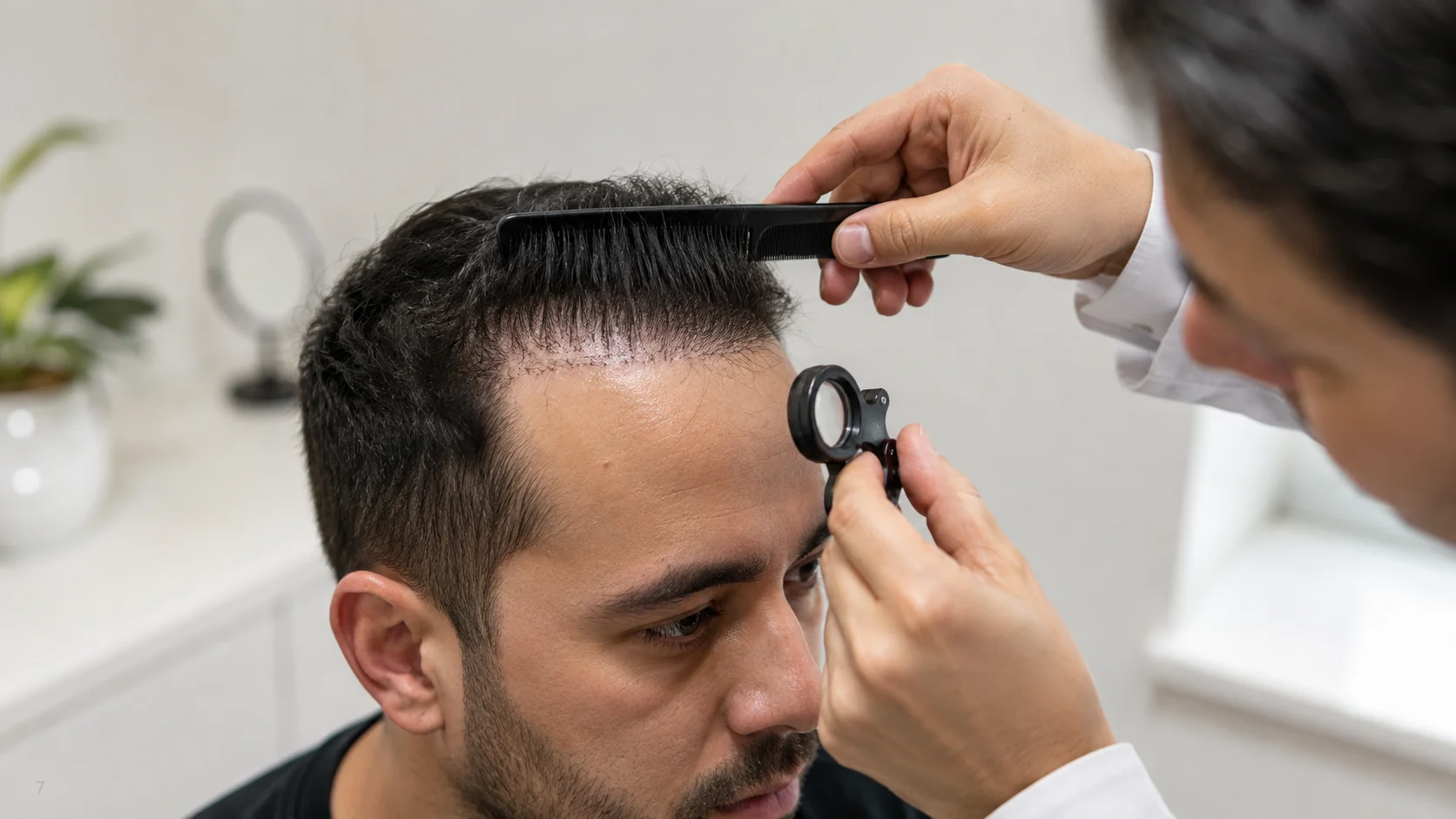
A hair transplant can achieve strong growth and still look unnatural. Naturalness depends on whether the hairline shape, follicular-unit size, graft angle, direction, curl, and density distribution reproduce the way hair normally grows.
These details are especially important at the frontal edge and temples, where individual hairs are visible. Technical errors may become more obvious over time as surrounding native hair continues to thin.
An Overly Low Hairline
A low hairline may use large numbers of grafts and fail to match the person’s age or expected future loss. It can also reduce the donor supply available for the mid-scalp and crown.
A youthful position may initially seem attractive but appear increasingly artificial as facial features mature. If native hair recedes behind it, the transplanted front can become an isolated strip.
Conservative placement does not mean the hairline must look excessively high. It means balancing facial proportions, current loss, donor capacity, age, and likely progression.
A Straight or Geometric Frontal Edge
Natural hairlines are not perfectly straight. They contain subtle irregularity, small projections, changes in density, and some asymmetry.
A sharply drawn horizontal line can resemble a boundary rather than natural growth. Repetitive rows or regularly spaced grafts may create a grid-like appearance.
Irregularity should remain controlled. Random placement without anatomical planning can look uneven rather than natural.
An Incorrect Frontotemporal Shape
The frontal hairline does not exist independently from the temples. Natural adult hairlines usually include frontotemporal recession and defined angles.
Rounding these corners or closing them aggressively can create a helmet-like shape. Temple restoration is particularly demanding because native temple hair is often fine, lies close to the skin, and follows sharply downward directions.
Coarse multi-hair grafts or upright placement in this area can remain conspicuous even when growth is excellent.
Multi-Hair Grafts at the Hairline
Natural frontal edges commonly begin with irregularly distributed single hairs. Density and follicular-unit size increase gradually behind this transition.
Placing two-, three-, or four-hair units at the first visible row can create a pluggy or “doll’s hair” effect. This problem becomes more obvious when the grafts are thick, dark, regularly spaced, or surrounded by pale scalp.
Multi-hair units are valuable for creating volume behind the hairline. The problem is their location, not their existence.
Incorrect Graft Angles
Hair does not emerge vertically from most of the scalp. At the frontal hairline, hairs generally leave the skin at an acute angle and lie forward. Temple hairs often sit even flatter.
Grafts placed too upright may stick up regardless of styling. Incorrect depth or forceful implantation can also change how they emerge.
The angle must be planned at the recipient-site stage and maintained during implantation. Once a graft heals, styling cannot permanently alter its biological exit angle.
Wrong Hair Direction
Direction describes where the shaft points across the surface of the scalp. Frontal hairs generally move forward with local variations, while temple hair points downward and backward in specific patterns.
The crown contains a rotating whorl. Grafts that ignore its center and direction may cross one another, create a fan-like mismatch, or resist natural styling.
Direction should also account for existing hair. Even anatomically plausible placement can look wrong when it conflicts with the person’s native growth.
Poor Density Distribution
Natural density is not uniform. The frontal transition is softer, coverage strengthens behind it, and distribution changes through the mid-scalp and crown.
Uniform low density across a large area may produce a see-through result. Concentrating all grafts at a very low hairline can leave an abrupt dense wall followed by an empty scalp.
A strategic plan creates visual priority. The frontal region often receives greater emphasis because it frames the face, while the crown may be treated more conservatively to preserve donor reserves.
Mismatched Hair Characteristics
Donor hair may be coarser, curlier, or lighter than the original frontal or temple hair. These differences cannot be completely changed by transplantation.
Careful graft selection can reduce mismatch. Finer single hairs may be reserved for exposed borders, while thicker multi-hair grafts provide coverage farther back.
Beard hair can add bulk in selected repair cases but is usually too coarse for an unprotected frontal edge.
Pitting, Cobblestoning, and Scarring
Grafts placed too deeply can create small depressions. Grafts that sit too high or incisions that heal with excess tissue can contribute to bumps and surface irregularity.
Scalp texture becomes especially visible when hair is short or density is low. Adding more grafts does not necessarily correct an abnormal surface and can increase trauma.
Continuing Native Hair Loss
A transplant can look natural initially and become unnatural later when untreated native hairs disappear. This may leave:
- An isolated frontal forelock
- Empty channels behind the hairline
- A transplanted crown surrounded by expanding loss
- Sharp differences between transplanted and native density
Long-term planning and appropriate medical treatment can reduce this risk, although progression cannot be predicted perfectly.
Can an Unnatural Result Be Repaired?
Repair depends on the specific problem and remaining donor supply.
A straight or pluggy edge may be softened with fine single-hair grafts. Selected low or misangled grafts may be removed and occasionally reused. Poor density may be improved with additional placement if the donor area remains adequate.
Scalp micropigmentation can reduce contrast but cannot correct hair direction or remove a low hairline. Laser hair removal or electrolysis may be considered in limited situations, but they can require multiple sessions and may affect the surrounding skin.
Complex repairs often require staged treatment.
Frequently Asked Questions
Why does a dense transplant sometimes look artificial?
Density cannot compensate for a low design, straight edge, large frontal grafts, or incorrect angles. Greater density may make these errors more visible.
Can transplanted hairs be trained into a new direction?
Styling can temporarily control them, but it cannot change the angle and direction established during implantation.
Should a hairline be symmetrical?
It should be balanced, but perfect geometric symmetry can appear artificial. Natural hairlines contain controlled irregularity.
Can incorrect grafts be removed?
Selected grafts may be extracted or destroyed, but removal can leave scars, pigment changes, or reduced survival if the grafts are reused.
Why can a transplant become unnatural years later?
Continuing native hair loss may expose a design that did not reserve grafts or account for progression.
Naturalness Is More Than Graft Count
A believable result depends on anatomical design and precise execution. Appropriate hairline height, subtle irregularity, fine frontal grafts, low exit angles, coordinated directions, and strategic density matter more than reaching the largest possible graft number.
This content is for general informational purposes and does not replace individualized medical advice, diagnosis, or treatment.