The crown, also called the vertex, presents different hair transplant challenges from the frontal scalp. It covers a potentially large and expanding surface, contains a rotating growth pattern, and can consume substantial donor resources without producing the same visual impact as frontal restoration.
Successful crown treatment depends on correct whorl design, strategic density, stable hair loss, and conservative use of a finite donor supply.
Understanding Crown Anatomy
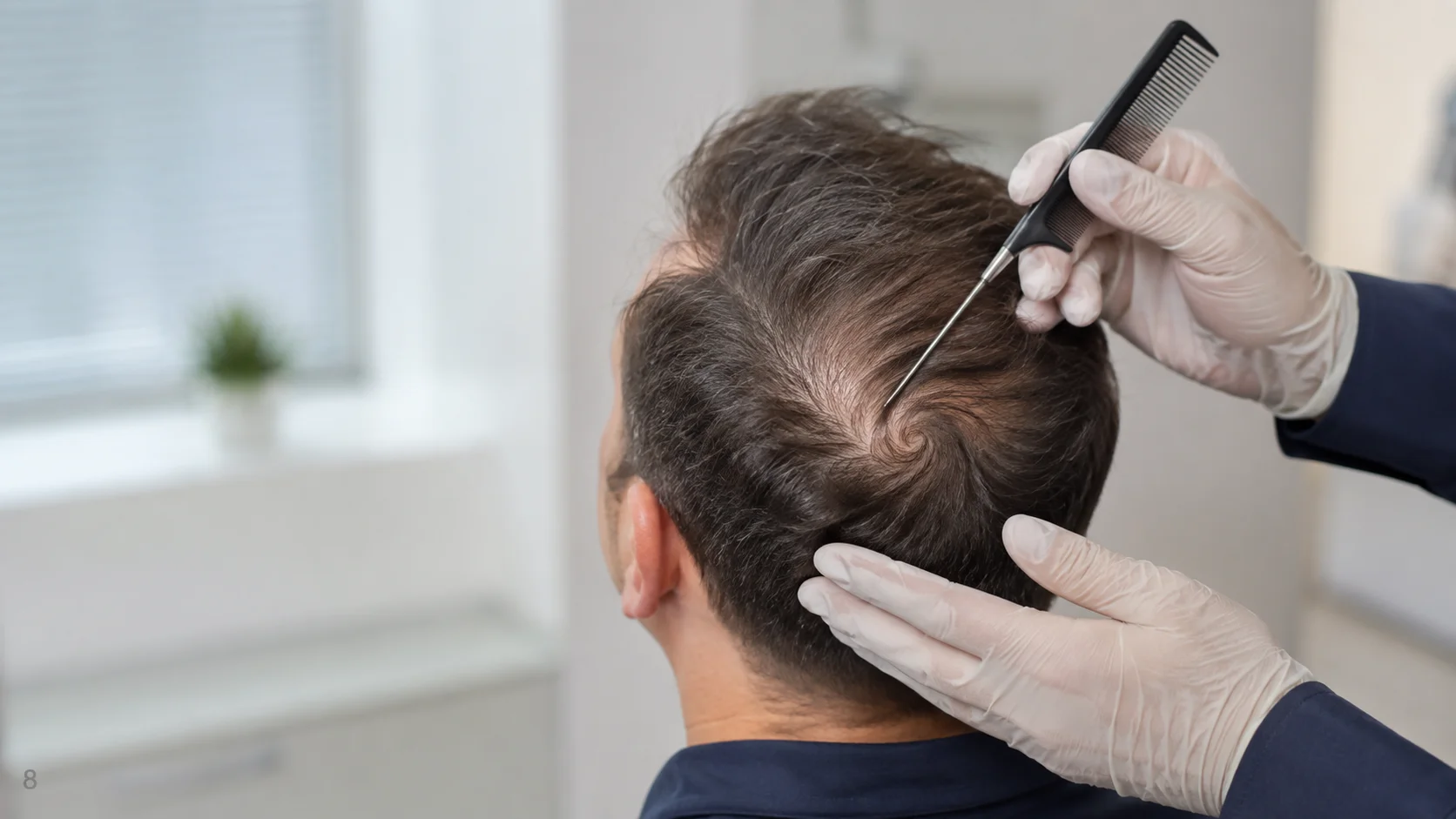
Crown hair usually grows around one or more whorl centers. Shafts change direction as they rotate outward, producing a spiral pattern that varies between individuals.
The whorl may rotate clockwise or counterclockwise and may sit centrally or asymmetrically. Some people naturally have two whorls.
A transplant should reproduce the person’s existing pattern when it remains identifiable. Inventing a new center or directing every graft radially without considering native hair can make the result difficult to style and visibly artificial.
Why the Crown Requires So Many Grafts
The crown is a broad horizontal surface viewed from above. As hair loss progresses, the affected circle can expand substantially toward the mid-scalp and donor fringe.
Grafts placed into a spiral also point in multiple directions. Unlike forward-combed frontal hair, crown hair provides less opportunity for one region to overlap and conceal a large area.
Attempting uniform high density can consume thousands of grafts while still failing to recreate natural density. The donor area may then be unable to support future frontal or mid-scalp needs.
Why the Front Often Has Priority
The frontal scalp frames the face and is visible during most interactions. A moderate number of well-positioned frontal grafts can therefore create a larger cosmetic change than the same number distributed throughout a large crown.
This does not mean crown transplantation is never appropriate. It means the crown should be considered within the whole scalp plan.
When donor supply is limited, a common priority is:
- Establish an appropriate frontal frame.
- Connect or strengthen the mid-scalp.
- Treat the crown conservatively if sufficient donor hair remains.
Personal priorities matter, but they cannot create additional donor capacity.
Who May Be a Crown Transplant Candidate?
Candidacy depends on:
- A confirmed diagnosis of androgenetic alopecia
- A sufficiently stable pattern
- Adequate donor density
- A clearly defined safe donor zone
- Realistic density expectations
- Crown size and rate of expansion
- Age and family history
- Existing frontal and mid-scalp coverage
- Previous graft use
- Willingness to consider medical stabilization
Caution is particularly important in younger patients with early vertex thinning. A small crown area can expand considerably, leaving a transplanted center surrounded by continuing loss.
Medical Treatment Before Surgery
Finasteride may slow androgen-driven miniaturization in suitable men, while topical or medically supervised oral minoxidil may strengthen surviving hairs. Treatment can sometimes improve the crown enough to change the surgical plan.
Medication cannot guarantee stabilization and must be evaluated over an appropriate period. Potential adverse effects and contraindications require individualized discussion.
A transplant should not be used as a substitute for diagnosing sudden crown shedding or active inflammatory disease.
Designing the Whorl
Recipient sites must follow the changing angle and direction around the natural center. The transition from the mid-scalp into the vertex should be gradual rather than forming a visible circular boundary.
The whorl center may appear thinner than surrounding regions even in people without hair loss because hairs separate in multiple directions. Overpacking this point can use many grafts without producing proportional coverage.
Design should account for the hairstyle. Longer hair, curl, shaft thickness, and lower scalp contrast can create better visual coverage from conservative density.
Strategic Graft Distribution
Crown planning often uses variable rather than uniform density. More grafts may be placed where they produce useful overlap, while lower density is accepted in less visible or potentially expanding regions.
Multi-hair follicular units can provide volume, but they must follow the local spiral. Single hairs may be used for subtle transitions or where existing hairs require delicate blending.
The total hair count matters as much as the graft count. A crown receiving predominantly single-hair units will have less coverage than one receiving suitable multi-hair units.
How Long Crown Results Take
Crown growth can appear slower than frontal growth. Early shedding is expected, and initial regrowth may be fine, uneven, and difficult to appreciate.
Meaningful improvement often takes many months. Final evaluation may require 12 to 18 months, depending on individual growth and maturation.
A result should not be labeled unsuccessful simply because the crown remains thin during the early growth phase.
Crown Shock Loss
Surgery can trigger temporary shedding of nearby native hairs. Healthy follicles may recover, but severely miniaturized hairs can be less predictable.
Dense placement among weak native hair may create an initial period in which the crown looks worse. Preoperative counseling should distinguish temporary shedding from permanent progression.
Risks of Treating the Crown Too Aggressively
An aggressive crown procedure can:
- Deplete donor reserves
- Limit future frontal repair
- Produce a transplanted island as loss expands
- Create an artificial whorl
- Damage miniaturized native hairs
- Leave insufficient density across a large area
- Make later procedures more difficult
The largest technically possible session is not necessarily the safest long-term plan.
Frequently Asked Questions
How many grafts does a crown transplant require?
There is no standard number. Crown size, existing hair, shaft caliber, hairs per graft, whorl design, and target density all influence the estimate.
Can the crown be transplanted without treating the front?
It may be possible in selected stable patterns, but future frontal and mid-scalp loss must be considered before donor hair is committed to the vertex.
Why does crown growth take longer to judge?
The spiral pattern, broad viewing angle, hair-cycle variation, and gradual shaft maturation can delay visible coverage.
Can transplanted crown hair thin again?
Stable donor follicles generally retain their characteristics, but grafts taken outside the safe zone may miniaturize. Surrounding native hair can also continue thinning.
Can medication replace crown surgery?
Medication may stabilize loss or improve miniaturized hair, particularly when started before advanced baldness. Response varies and may not provide the density a suitable surgical candidate wants.
Planning the Crown as Part of the Whole Scalp
The crown should not be treated as an isolated circle. Its expanding surface, spiral architecture, and high graft demand make lifetime donor planning essential. Conservative distribution can preserve options while creating a natural transition from the mid-scalp into the vertex.
This content is for general informational purposes and does not replace individualized medical advice, diagnosis, or treatment.