5-alpha reductase is an enzyme that converts testosterone into dihydrotestosterone, commonly called DHT. This conversion is a normal biological process, but it matters in androgenetic alopecia because DHT can gradually miniaturize genetically susceptible scalp follicles. The enzyme does not directly "attack" hair — it changes the local androgen environment, while the follicle's genetics and receptor activity determine how that environment affects growth.
Two related isoforms, type 1 and type 2, do most of the work relevant to hair loss. They perform the same basic chemical conversion but differ in their genes, tissue distribution, and sensitivity to medication — a distinction that explains why finasteride and dutasteride suppress DHT to different degrees.
What Does 5-Alpha Reductase Do?
Enzymes help chemical reactions occur within the body. 5-alpha reductase changes the structure of certain steroid hormones, including testosterone. When testosterone is converted into DHT, the resulting hormone creates a stronger androgen-receptor signal in several tissues, contributing to development of male external genitalia before birth, prostate growth and function, facial and body hair development, sebaceous gland activity, and androgenetic scalp hair loss in susceptible people. DHT is therefore not simply a harmful hormone — its effects depend on the tissue and stage of life.
Where the Enzyme Is Found
5-alpha reductase is active in tissues including the skin, scalp, hair follicles, prostate, liver, and reproductive tissues, and its distribution varies by isoform. Type 1 is prominent in skin and sebaceous glands, including scalp sebaceous glands and parts of the nervous system and liver. Type 2 is concentrated in hair-follicle structures, the prostate, genital skin, and other androgen-responsive tissue, and has been localized specifically to parts of the follicular root sheath.
Within the scalp, relevant activity occurs in and around follicular structures and sebaceous glands. This local conversion means that serum testosterone or DHT does not fully describe the androgen environment experienced by a particular follicle — two people with similar blood hormone levels can have different local enzyme activity and very different hair patterns.
Type 1 and Type 2: What Actually Differs
The body often uses several versions of an enzyme to perform related functions in different tissues. Type 1 and type 2 5-alpha reductase are encoded by separate genes, SRD5A1 and SRD5A2 — a third form, type 3 (SRD5A3), also exists but its biological roles extend beyond the usual discussion of DHT and hair loss, and it is not the target of established androgenetic alopecia medications.
Both isoforms can convert testosterone into DHT, and the resulting DHT molecule is identical regardless of which enzyme produced it — it is therefore inaccurate to describe "type 1 DHT" and "type 2 DHT" as different hormones. The distinction concerns where, when, and under what local conditions the conversion happens; tissue acidity, enzyme concentration, androgen availability, and cellular location all influence activity.
Type 2 has the most clearly demonstrated clinical role in male pattern hair loss. Finasteride, which primarily inhibits type 2, improves hair counts and slows progression in many men — proof that meaningful benefit can occur without fully inhibiting type 1. Type 1 may still contribute to the broader scalp androgen environment, and its presence may help explain why dual-enzyme inhibition lowers DHT more strongly than selective type 2 inhibition. Androgenetic alopecia still requires genetically susceptible follicles — neither enzyme causes the pattern independently of receptor and follicle biology.
How DHT Affects Susceptible Follicles
DHT binds to androgen receptors in responsive follicle cells. In genetically susceptible frontal and crown follicles, the resulting signals shorten the active growth phase and contribute to progressive miniaturization. Across repeated cycles, the hair becomes finer, shorter, less pigmented, less effective at covering the scalp, and increasingly similar to a vellus hair.
The follicle is not usually destroyed at the beginning of this process. Early or moderately miniaturized follicles may still respond to treatment, while long-standing severe miniaturization is harder to reverse.
Why Only Some People Develop Pattern Hair Loss
Most adults produce DHT, but not everyone develops significant androgenetic alopecia — the missing factor is susceptibility. Genetic differences influence androgen-receptor activity, local hormone metabolism, growth-factor signaling, and the regional behavior of follicles: some scalp follicles interpret ordinary DHT exposure as a miniaturizing signal, while others remain resistant. A 2017 genome-wide meta-analysis of over 22,000 men identified 63 risk loci contributing to this susceptibility (23 not previously reported), together explaining roughly 39% of the variance in who develops the condition — confirming that male-pattern baldness is a polygenic trait shaped by many genes acting together, not a single-gene condition (Heilmann-Heimbach S et al., Nature Communications 2017).
This is why a person can have normal hormone tests and still lose hair, and why another person can have relatively high androgen levels without becoming bald.
Evidence for the Enzyme's Role in Baldness
Several findings support the importance of 5-alpha reductase and DHT in male pattern hair loss: balding scalp can show higher DHT or androgen-metabolism activity than resistant scalp; men with an inherited deficiency of type 2 5-alpha reductase generally do not develop typical male pattern baldness; and reducing DHT pharmacologically slows progression and improves hair counts in many eligible men. In the pivotal dose-ranging study, finasteride 1 mg reduced scalp DHT by roughly 64% and serum DHT by roughly 71%; serum DHT reduction was already close to that level at the 0.2 mg dose (71.4%, statistically the same as 1 mg), while scalp DHT reduction continued to increase somewhat between 0.2 mg (56.5%) and 1 mg (64.1%) (Drake L et al., J Am Acad Dermatol 1999). These findings establish the pathway as important, but they do not make it the only process involved in hair growth.
Finasteride vs Dutasteride
The medication comparison mirrors the enzyme comparison.
Finasteride
Finasteride primarily inhibits type 2 5-alpha reductase, substantially lowering serum and scalp DHT. It does not directly block the androgen receptor, eliminate testosterone, or permanently change follicle genetics, and its protective effect generally continues only while treatment is maintained. Potential sexual, reproductive, breast, and mood-related adverse effects require informed discussion, and it also affects PSA interpretation and carries pregnancy-related handling precautions.
Dutasteride
Dutasteride inhibits both type 1 and type 2, typically producing greater suppression of circulating DHT than finasteride. In a 24-week randomized, placebo-controlled trial of 416 men comparing several dutasteride doses (0.05–2.5 mg) against finasteride and placebo, the 2.5 mg dutasteride arm outperformed the finasteride arm on hair-count measures at both 12 and 24 weeks (Olsen EA et al., J Am Acad Dermatol 2006). One dosing detail matters for interpreting this: the finasteride comparator in that trial was 5 mg — five times the 1 mg dose actually used for hair loss (5 mg is the dose used for enlarged prostate) — so this result shows dutasteride 2.5 mg outperforming a high finasteride dose, not necessarily the everyday 1 mg prescription most men are given. Greater enzyme inhibition does not automatically make it the correct first treatment for everyone: regulatory approval for hair loss varies by country, the drug remains in the body considerably longer, and dose escalation or combining enzyme inhibitors without medical supervision can add risk without guaranteeing a better result.
Is Dual Inhibition Always Better?
Dual inhibition generally lowers DHT more strongly and may produce greater average hair-count improvement in some populations. Yet the best treatment is not determined by DHT reduction alone — expected benefit, potential adverse effects, drug persistence, fertility and pregnancy issues, age and health history, regulatory status, patient preference, and long-term adherence all matter. A person doing well on type 2 inhibition alone may gain little practical value from switching.
Does Type 1 Activity Explain Finasteride Non-Response?
Not by itself. Continued type 1 activity is one possible biological consideration, but poor response to finasteride can have many other explanations: incorrect diagnosis, advanced follicle miniaturization, inconsistent treatment, insufficient treatment duration, ongoing telogen effluvium, scalp inflammation, nutritional or endocrine contributors, genetic variation in treatment response, or unrealistic expectations. Switching to stronger DHT suppression without reviewing these possibilities may add risk while missing the real problem.
Do Women Have Both Types?
Yes. Women also express both 5-alpha reductase isoforms and produce DHT, but female pattern hair loss involves androgen sensitivity in a more heterogeneous way than the classic male pattern — many affected women have entirely normal circulating androgen levels. Antiandrogen or 5-alpha-reductase-inhibiting treatments require specialist assessment in women because the evidence base, pregnancy risks, and regulatory approval all differ from those established in men. The presence of the enzymes does not mean every woman with thinning needs DHT-directed treatment.
Do Natural DHT Blockers Inhibit the Same Enzyme?
Some botanical ingredients demonstrate possible 5-alpha-reductase activity in laboratory research; saw palmetto is a common example. Laboratory activity does not establish clinical equivalence to prescription medication — botanical preparations vary in extraction, concentration, purity, and supporting evidence, and should not be assumed to reduce scalp DHT as predictably or as strongly as finasteride. Natural origin also does not guarantee freedom from hormonal effects or medication interactions.
Can Enzyme Activity Be Tested?
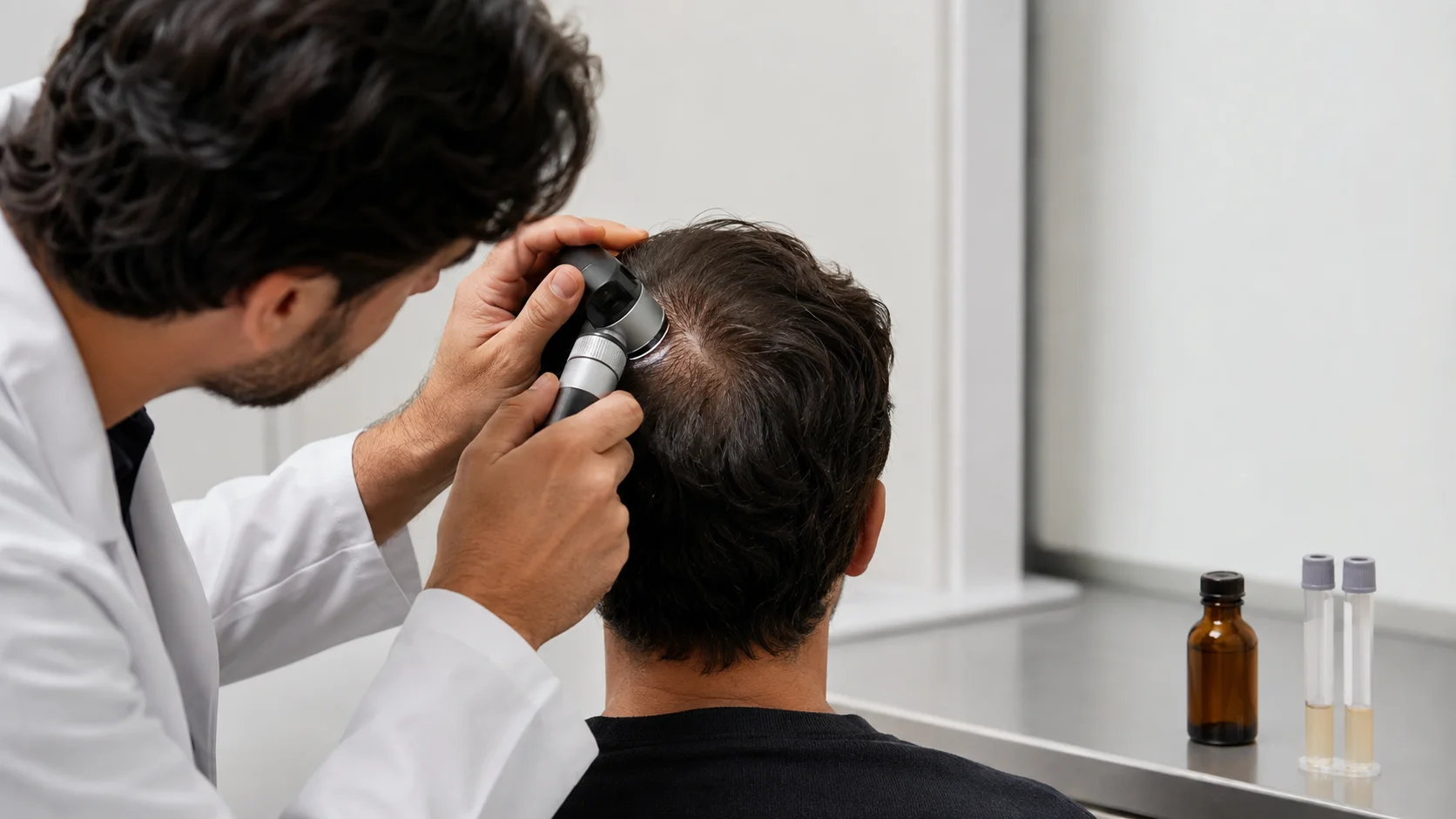
Routine blood tests do not separately measure the activity of each isoform within a person's scalp follicles. Serum DHT reflects the combined result of production, metabolism, and clearance across the whole body — it cannot reveal how much DHT a specific follicle produced through type 1 versus type 2 activity, and genetic testing for rare enzyme disorders is a research tool, not a standard method for choosing common hair-loss treatment. Androgenetic alopecia is instead diagnosed from its characteristic distribution, progressive changes over time, variation in hair-shaft diameter, follicle miniaturization on magnified examination, and family and medical history; laboratory testing becomes more relevant when the presentation suggests another hormonal, nutritional, or medical cause. Clinical diagnosis and treatment response remain more useful than attempting to assign a personal "type 1 versus type 2" ratio — and type 1 activity in sebaceous glands, while relevant to acne and oily skin, is not by itself a reason to choose a dual-inhibiting medication.
Does Blocking the Enzyme Stop All Hair Loss?
No. 5-alpha-reductase inhibitors target androgen-related miniaturization specifically — they do not correct telogen effluvium, iron deficiency, thyroid disease, alopecia areata, scarring alopecia, traction, or hair breakage. Even in confirmed androgenetic alopecia, response is incomplete in some people: follicles may already be severely miniaturized, treatment may begin late, or growth-supporting pathways may also need attention alongside enzyme inhibition.
Frequently Asked Questions
Is 5-alpha reductase the same as DHT?
No. 5-alpha reductase is the enzyme; DHT is one of the hormones produced through its activity.
Which type does finasteride block?
Finasteride primarily inhibits type 2 5-alpha reductase.
Which types does dutasteride block?
Dutasteride inhibits both type 1 and type 2 5-alpha reductase.
Is type 2 more important for baldness?
Type 2 has the strongest established connection to male androgenetic alopecia and is a proven therapeutic target; type 1 contributes to the broader androgen environment but is not required for treatment to work.
Does the enzyme increase with age?
Local androgen metabolism can change with age, but hair-loss progression cannot be explained by one universal rise in enzyme activity — genetics and repeated follicle cycling remain more important.
Does inhibiting more enzyme always produce more hair?
Not necessarily. Response depends on follicle viability, diagnosis, genetics, treatment duration, and other growth pathways — not on DHT suppression alone.